Wading into monthly retainers and one-off projects can feel confusing. This guide lays out typical ranges, what plans usually include, and how to spot wasted spend. Monthly fees in Australia often span from about $500 up to $10,000+, with many businesses spending around $1,800–$2,200 per month.
Pricing changes with competition, site health, and how much work is done each month — not because the field is mysterious.
We’ll compare hourly, monthly retainer, and project models so you know which fits your goals and budget. Cheap work can cost more later if it causes penalties or needs rework.
In 2026, modern efforts often include visibility in AI answers, which can shift deliverables and affect cost. Read on to get clear tier breakdowns, scope checklists, and questions to ask an agency before you sign.
Key Takeaways
- Expect broad monthly ranges from roughly $500 to $10,000+ depending on scope.
- Costs reflect competition, site condition, and monthly work, not mystery.
- Choose hourly, retainer, or project pricing based on goals and scale.
- Cheap options can trigger penalties or long delays and raise total spend.
- AI visibility in 2026 may change deliverables and affect pricing.
- This guide gives tier examples, scope checklists, and agency questions.
Why SEO Pricing Feels All Over the Place (and Why That’s Normal)
What feels like chaotic pricing usually comes from real differences in scope, skill, and intent.
SEO is a long-term investment, not a one-time switch
Reputable agencies frame work as an investment that compounds after the last invoice. Gains often show over months, not after one week.
Deliverables and quality vary more than the dollar amount
Two proposals can list the same monthly total but hide different scopes, risk profiles, and expertise. One may fix technical issues and build authority. Another may only run surface tasks.
What “transparent” looks like when you compare providers
Transparency means clear deliverables, ownership for who uploads changes, a reporting cadence, and a sensible timeline. Ask to see a roadmap, backlog, audit findings, and KPIs that tie to real results.
Watch for red flags: pay-per-keyword offers and quick spikes that vanish when you stop paying often signal risky tactics like PBNs.
SEO Service Price In Australiya: Typical Costs You’ll See in Today’s Market
Here’s a clear snapshot of common market ranges and what they actually buy you.
Common monthly retainer range
Monthly retainers often span from about $500 to $10,000+ depending on scope. A more frequent market bracket quoted is $1,400–$10,000 per month, while summaries often list $500–$5,000 for smaller campaigns.
Average monthly spend benchmarks
The typical spend many businesses land near is roughly $1,800–$2,200 per month. That average shows what many choose, but average doesn’t mean right for your business.
Once-off setup and foundational package ranges
Foundational, one-time setups commonly range from $3,000–$10,000+. Corrective or small foundations may sit at $3,000–$6,000, while larger packages (content + technical + links) often fall in $5,000–$10,000.
- What you’ll see in proposals: clear monthly tasks, initial fixes, and measurement goals.
- Low-end retainers usually cover audits and basic on-page work; high-end retainers add content, link campaigns, and reporting.
- Ask what happens in month 1 vs month 2 vs month 3 and what “done” looks like.
Buying tip: focus on measurable progress toward qualified search traffic and leads, not just a task list or a single dollar figure.
Monthly SEO Pricing Tiers: Entry-Level, Growth, and Authority Campaigns
Not all monthly retainers are equal—tiers clarify what your budget actually buys.
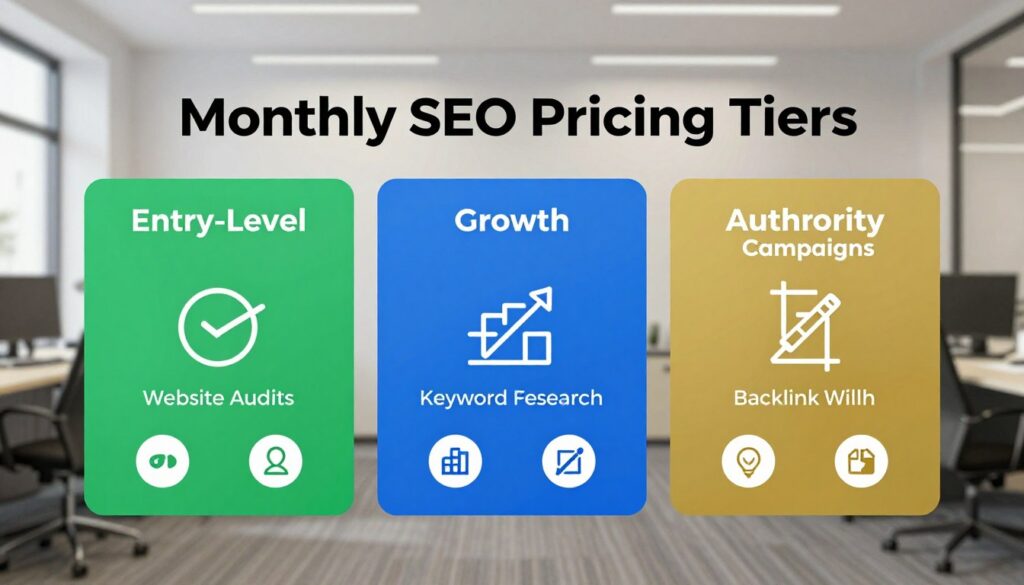
Entry-level per month: what’s usually included (and what’s missing)
Typical range: $500–$1,000 per month.
This tier covers a light audit, basic on-page fixes, and foundational maintenance. It often includes minimal content work and few or no link building efforts.
Why it can fall short: Competitive markets need deeper technical and content work that entry retainers rarely deliver.
Growth-focused per month: where many small business campaigns gain traction
Typical range: $1,500–$3,000 per month.
Expect regular on-page updates, steady content production, and a modest link campaign. This is the traction zone for many SMBs.
Authority per month: for national, eCommerce, and enterprise
Typical range: $5,000+ per month.
These campaigns add ongoing technical seo work, content engines, and digital PR that scale visibility for large sites and national reach.
How to sanity-check the scope behind a monthly cost
“Translate monthly pricing into hours and roles: strategist, technical, content, outreach.”
- Check pages optimized per month and content pieces delivered.
- Ask about link building / PR activity and technical backlog items shipped.
- Convert the monthly fee into estimated hours to see if the scope is realistic.
Hourly Rates vs. Monthly Retainers: Which SEO Pricing Model Fits Your Needs?
The right model depends on whether you need short, focused help or steady effort that compounds over time. Hourly consulting gives targeted expertise for tight problems. Monthly retainers fund ongoing work that builds traffic and authority.
Typical hourly rate ranges and what drives the higher end
Hourly rates commonly sit around $100–$180/hr in many guides. Some sources show ranges that go to $200/hr or even $300/hr for elite specialists.
Why higher rates? Senior experts charge more because they diagnose issues faster, make higher-quality calls, and reduce trial-and-error hours.
When hourly work makes sense
Hourly billing is ideal for scoped tasks like a one-time audit, a migration fire drill, or a GA4 and GSC training session.
Use hourly when you want a short project or to validate an in-house plan without a long commitment.
Why many agencies price by job instead of by hour
One deliverable often requires a strategist, a technical expert, a developer, and a writer. Quoting by job avoids complex hourly splits and protects buyers from unpredictable invoices.
Buyer tip: If you accept hourly work, insist on a written scope, deliverables, and acceptance criteria. Buy outcomes, not just time.
| Model | Typical rates / range | Best for |
|---|---|---|
| Hourly | $100–$180/hr (up to $300 for top experts) | Audits, emergency fixes, short training |
| By job | Fixed per project based on scope | Migrations, full audits, content projects |
| Monthly retainer | $500–$10,000+/month depending on scope | Ongoing growth, technical seo, content engines |
“Hourly for targeted expertise; monthly for steady growth.”
Project-Based SEO Pricing for One-Time Work (Audits, Migrations, and Fixes)
When you want a single, scoped output—such as a migration plan or technical audit—a project model fits best.
Project work means a defined deliverable with a clear start and finish. It is ideal when you need a one-time fix or a documented plan to hand to your team.
What a real audit should include
A proper audit (commonly $2,000–$5,000) lists crawl findings, indexation issues, internal linking gaps, content shortfalls, and prioritized actions.
Expect a readable report, clear next steps, and tags for pages that need fixes.
Why migrations cost more
Migrations often run $3,000–$10,000 because errors can remove traffic fast.
Good work includes redirect mapping, QA, rollout checks, and post-launch validation.
Foundational project vs ongoing campaign
Foundational optimisation projects (often $3,500–$10,000+) clean up site health and set baselines.
Ongoing campaigns add content, authority building, and iterative improvements over time.
“Projects give a clear stop and deliverable; retainers sustain growth.”
- Checklist: deliverable format, tools used, access needs, implementation support, post-project validation.
- Timelines: projects take weeks; results need search engines to recrawl.
- Move to a retainer when competition and content needs are continuous.
| Project type | Typical cost range | Primary deliverable |
|---|---|---|
| Technical audit | $2,000–$5,000 | Audit report + prioritized fixes |
| Website migration | $3,000–$10,000 | Redirect map, QA, post-launch checks |
| Foundational optimisation | $3,500–$10,000+ | Baseline fixes, page optimisation, setup |
What Impacts SEO Costs the Most: Competition, Website Size, and Scope
Understanding what drives costs helps you forecast budgets before you ask for quotes. Start by mapping your competitive landscape, the website size, and the scope of work you need.
Industry competition and time to win rankings
Some industries are crowded. High competition means more content, links, and technical work to compete.
Website size, pages, and true workload
Larger sites need more audits, template fixes, and QA. Each extra page adds review time and internal linking work.
Geographic targeting: local vs multi-location vs national
Local campaigns often cost less than national ones. Multi-location work multiplies landing pages and listing management.
Past work, penalties, and cleanup costs
Toxic links or old spammy content can inflate costs because cleanup and recovery take months. Some penalties need 6+ months to resolve.
Content depth and modern keyword mapping
Today, one page can capture many keywords. That means content depth and topic mapping expand scope more than buying single terms.
“The best proposal links scope to your competition and the condition of your website.”
- Predictors of cost: competition, site size, and deliverable scope.
- Match proposal detail to market reality and existing site health.
- Avoid cheap link schemes that create long cleanup bills.

What You’re Actually Paying For in an SEO Service Package
Break down any proposal into the work, hours, and outcomes behind the headline number.
Technical SEO covers crawl and index fixes, site speed upgrades, clean URL structure, and schema markup. Expect prioritized tickets and developer-ready tickets for fixes.
On-page optimisation means template fixes, page-level updates, internal linking improvements, and intent alignment so pages match what people search for.
Keyword research is a mapping exercise. Assign best-fit keywords to existing pages or plan new landing pages that can convert.
Content work includes new landing pages, topic clusters, and ongoing updates that grow organic traffic over months.
Link building and digital PR focus on earning relevant mentions and links that lift authority and cut reliance on ads.
Reporting that matters ties visibility to leads, conversions, and revenue where possible — not just raw rank lists.
| Component | Typical Deliverable | Business Impact |
|---|---|---|
| Technical | Crawl fixes, speed, schema, tickets | Improves indexation and UX |
| On-page | Page templates, internal links, intent mapping | Higher relevance and conversion |
| Content & Links | Landing pages, content updates, earned links | Steady traffic growth and authority |
Cheap SEO vs. Quality SEO: How to Avoid Costly Mistakes
Cut-rate packages may look tempting, but they often hide shortcuts that cost you more later. Cheap seo usually means low effort, automated tactics, spam links, and generic reports that don’t map to your goals.
Why ultra-low-cost work can lead to penalties and lost traffic
Bulk tactics like a “1,000 backlink package” with exact-match anchors can trigger ranking drops and manual actions.
Recovery often takes more than six months and can dwarf the initial cost savings.
Low-quality link packages and exact-match anchor risks
Low-quality links and repeated anchor patterns look manipulative. They raise red flags for search engines and hurt long-term growth.
How to spot “too good to be true” deliverables
- Guaranteed rankings, vague deliverables, or “pay per keyword” promises.
- No technical work listed, no ownership clarity, or only bulk link claims.
- Lack of case studies with measurable results or real examples of earned links.
“The cheapest monthly fee can become the highest total cost when cleanup or stalled growth is required.”
What quality looks like: a clear plan, prioritized backlog, a real content and authority approach, and transparent reporting.
Ask for sample reports, examples of earned links, case metrics, and a risk-handling explanation before you buy.
Agency vs. In-House SEO: Comparing Real Costs and Capabilities
A headcount decision is more than salary math — it shapes capabilities, speed, and the kinds of campaigns you can run.
In-house salary ranges and true cost to seat
Junior hires often start near $60,000–$70,000/year. Senior roles run $80,000–$120,000, with specialist leads up to $190,000.
True cost to seat typically rises to about $95,000–$135,000 per year after recruiting, benefits, training, and tools — roughly $8,000–$11,250 per month.
Why one hire can’t replicate a full team
- Technical audits and developer tickets
- Content strategy and copywriting
- Digital PR and link earning
- Analytics, reporting, and project management
Hybrid approach: when to combine teams
A hybrid model pairs an internal stakeholder with an external team for execution or uses agency strategy with internal implementation.
This speeds impact while keeping domain knowledge inside the business.
| Option | Typical annual costs | Best when |
|---|---|---|
| In-house | $95k–$135k | Large sites, daily ops |
| Agency | Varies by campaign | Fast specialist access |
| Hybrid | Mix of both | Balanced control + speed |
Buyer tip: Compare capability gaps and speed-to-impact, not just the headline numbers.
How to Choose the Right SEO Agency for Your Budget (Without Overpaying)
Picking the right partner starts with a clear brief and realistic expectations about timelines and outcomes.
What a strong proposal should include
- Explicit scope: what’s in and out of the monthly work.
- Monthly deliverables: technical fixes, content pieces, and authority-building tasks.
- Ownership and implementation: who will push changes and who signs off.
- Timelines and reporting cadence with measurable KPIs.
Key questions to ask
- Who owns content and assets after delivery?
- Who pays for tools and subscriptions?
- How are links earned, and are tactics documented?
- What will you see in the first 90 days of the campaign?
Evaluating experience and proof
Ask for case studies with similar competition and market size. Look for before/after metrics that show sustainable results, not short spikes.
| Business | Typical monthly benchmark |
|---|---|
| Small business | $1,400–$2,500 |
| Medium business | $1,600–$7,500 |
| Large / enterprise | $2,500–$10,000+ |
Fairness check: if competition is high, ensure the agency budgets enough hours and expertise per month to compete.
Decision framework
- Match scope to your goals.
- Prefer transparent deliverables over low monthly numbers.
- Choose the provider that shows clear steps to measurable results.
Conclusion
Real buying power comes from matching deliverables to market friction—don’t buy numbers, buy outcomes.
Monthly ranges commonly run from about $500 up to $10,000+ per month, with many businesses near $1,800–$2,200 per month. One-off foundational projects often sit between $3,000 and $10,000+, and hourly help typically spans roughly $100–$300 per hour.
Focus your campaign on technical health, clear on-page alignment, steady content growth, and sustainable authority building. Use a simple scope sanity-check: does the monthly plan include enough work to move rankings in your market, and are reports tied to real outcomes?
Avoid cheap shortcuts like bulk link schemes that risk penalties and costly cleanup. Gather 2–3 proposals, ask transparency questions, and choose the partner whose scope matches your goals and timeline.
Think long term: consistent optimisation and ongoing content work compound. When active work slows, good foundations can keep driving search traffic for months and years.
FAQ
How much do monthly SEO retainers typically cost for Australian businesses?
Why do prices for search engine optimisation feel inconsistent between agencies?
What’s included in an entry-level monthly package versus an authority-level campaign?
Are hourly rates a better option than monthly retainers?
How much do project-based audits or migrations cost in Australia?
What factors most influence the total campaign cost?
What should I expect to be delivered in a solid optimisation package?
How can I avoid cheap offerings that risk my site’s performance?
Is it cheaper to hire in-house or use an agency?
How long before I see results after starting a campaign?
What questions should I ask when evaluating agencies or proposals?
How do keyword research and content depth affect campaign cost?
Can agencies guarantee top rankings or traffic increases?
What are common add-on costs I should budget for?
How do I compare proposals so I don’t overpay?

I am an SEO expert with over 7+ years of hands-on experience in search engine optimization, content strategy, and organic growth. I specialize in creating SEO-driven blog content that helps businesses improve search visibility, attract qualified traffic, and achieve sustainable rankings on Google. With a strong understanding of on-page SEO, keyword research, technical SEO, and content optimization, I focus on delivering data-backed, user-focused content that converts.
Related Posts

Effective Attorney Search Engine Marketing Strategies
What if nearly every potential client who needs your legal…
Boost Your Online Visibility with Professional SEO Marketing in Indore
I help Indore businesses win search attention and turn clicks…

Optimize Your Law Practice with a Winning Lawyer SEO Strategy
What if your ideal clients couldn't find you when they…